Permissionless
I was biking through Berlin, looking at faces.
It is summer, which matters here. Berlin spends most of the year gray and cold. When the sun finally lands, the city pours outside: parks, canal banks, cafés. People look good. Fit, mostly. Less American softness. Dogs, bikes, vegetables that taste like vegetables because the food here has not been bred for shelf life.
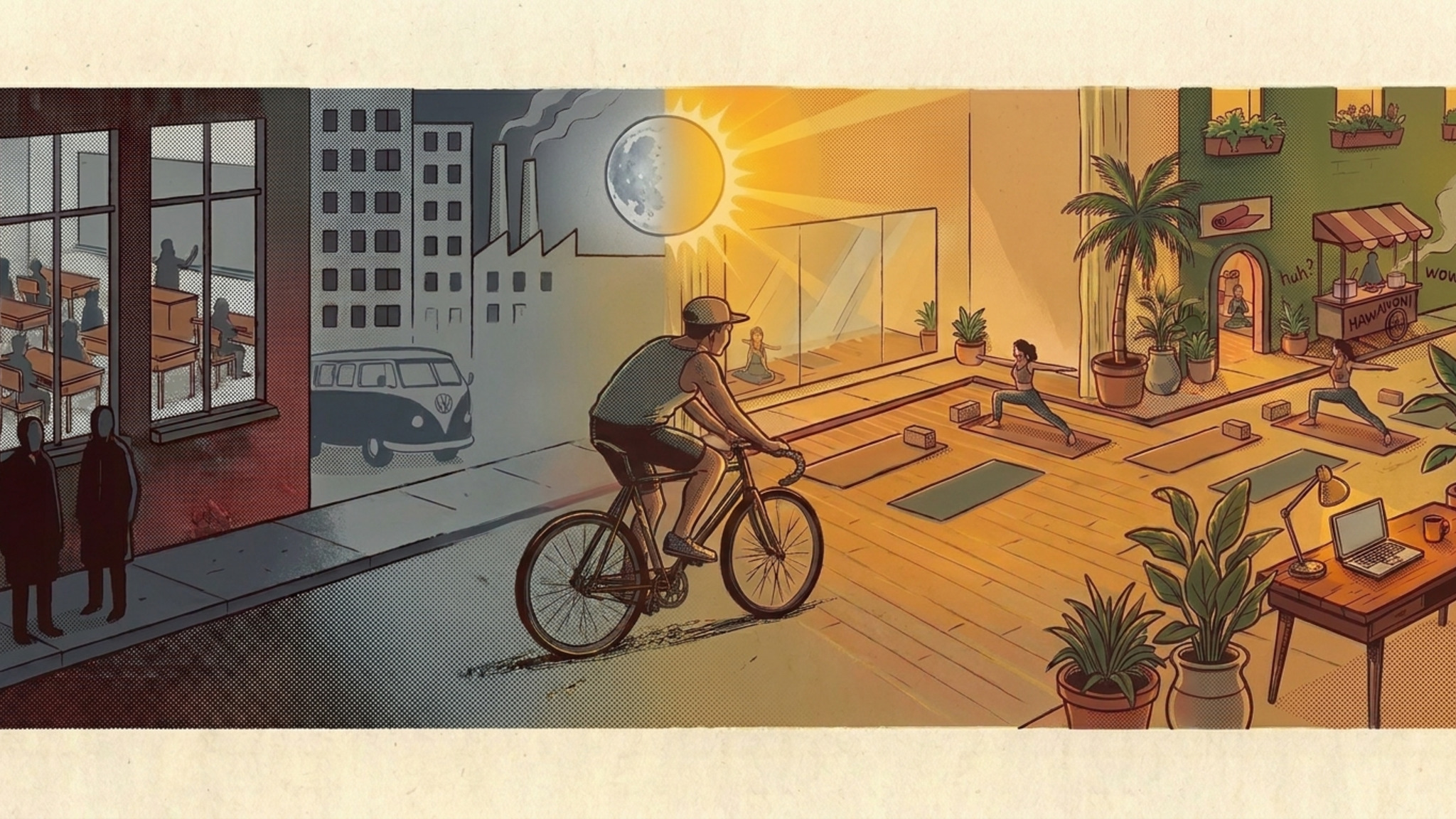
The city is full of bodies. The souls are harder to find.
In America we are no better at being, but the sickness shows a different face: phones, hustle, dopamine, the endless little performance of becoming. There is still a crackle to the place that I miss, a stubborn animal aliveness even in the people who are lost. Here I keep catching something quieter, as if that aliveness has been trampled down.
The ugly internet word for it is NPC. A non-player character. In a video game the NPC stands behind the counter, sells you the sword, repeats the one line it was written to say, points you to the next quest, and never breaks script. It is cruel to call a person that, I know, and it also names something true. People living inside a role, a lifestyle, a way of doing things they never chose.
Don Miguel Ruiz has a name for the script. In The Four Agreements he calls it the “dream of the planet,” a phrase that sounds almost beautiful, like some shared human vision we are all weaving together. That is not what he meant. He meant the collective story we inherit and mistake for the world: school, work, money, status, what a good life looks like, what you are allowed to want. We made almost all of it up. Then we forgot. Now we live inside a prison we built and call it the way things are.
Most people never wake from it because nobody told them there was anything to wake from. They go through the motions and assume this is what you get until you die.
Berlin is not stupid. It is one of the more intelligent places I have lived. But much of the intelligence is café intellectualism. People can hand you a flawless takedown of capitalism and patriarchy over a two-euro beer, then party until six, sleep poorly, show up hungover and miserable, and leave the condemned thing untouched. The analysis is sharp. Then nothing moves. Under it sits a low-grade frustration that does not take long to find, a grief with nowhere to go.
What I do not see much of is gusto. People lit from inside by something they are trying to build: a chef chasing a flavor, a teacher starting a school, a founder who cannot sleep because the thing is close.
I am not above any of this. I spent most of my life as an NPC too, doing what I thought I was supposed to do so I would be loved for doing it. My script was American instead of German: be exceptional, be useful, earn your place. Different cage, still a cage.
We are not above or below each other. We walk side by side across the same field, and every so often you put out a hand and say, here, come with me. That is all any of this is. A hand.
Becoming contemptuous toward Europe is the easy move, and that contempt is a lie. Europe is in many ways more sane than America. There is a rationality to it. People here are better informed than Americans about their food, their climate, the systems they live inside. They are also strangely resigned. In the Zero to One taxonomy, the word is indefinite pessimism: the future looks bleak, nobody has a real plan, so you wait. But why build if the answer has already been decided? Survivable, yes. Thriving, no.
I am writing this from the old capital of those old ideas. Berlin was the seat of Prussia, the German state that built much of the arrangement the modern world still lives in. Prussia gave us compulsory state schooling, the model nearly every country copied: rows of desks, bells, standard curriculum, citizens made orderly and legible. A century later, in this same city, Otto von Bismarck assembled the first welfare state: health, accident, and old-age insurance, a net stitched for one kind of person. A body in a factory. A wage. An employer. A predictable life.
That world worked because it was slow. Institutions could shape society over decades when society moved at the pace of paper and rail, and that pace is gone. Volkswagen is the example. After the war it was cool because it made sense: German engineering and export power turned into a people’s car that moved bodies and hearts. Now it is dull, low-risk, uninspired, and reportedly weighing up to a hundred thousand job cuts and the closure of four German plants. This is not a stumble. It is an old man coughing up blood.
The institutions cannot keep up. They are losing the authority to tell you where you fit, what is safe, and what is allowed.
Good.
There is an alternative to waiting, and Naval Ravikant put it cleanly. The old route to security was a salary. The real one is ownership: assets that work without you. If you were not born into capital, you start by productizing yourself, taking the specific knowledge only you have, the thing you know so naturally you do not even count it as knowledge, and wrapping it in something you can sell.
Everyone has specific knowledge. The rare part was leverage. Naval calls the new kind permissionless leverage: code and media, things that work while you sleep and need no one’s permission to make. AI makes that almost absurd. A person with specific knowledge and a laptop has a full staff for the first time in history. I build software with Claude Code and Codex that I could not have hired a team to make a year ago. The tools are here. They are real. This is the moment to productize yourself. It will not stay this open, or it will become normal so fast that the people who moved first are already gone.
You do not build for everyone. You build for a minimum viable audience, the smallest group that loves the specific thing you make and will pay for it. Serve them obsessively and you have a living that belongs to you.
Last week I met an Egyptian man who came to Berlin to make a better life. He is studying German and accounting. I told him the truth as I saw it: accounting is dead. A brutal thing to say to a man trying to build a life through it. He did not flinch. That told me he already knew.
So I asked what he loves. Cooking. He lit up and told me about hawawshi, spiced minced meat packed into bread and baked until the edges crisp, a thing every kid in Cairo knows and I had never heard of. For thirty seconds the listlessness was gone. He was completely there.
Most food stalls do not make you feel known. But they can. A good one becomes a little embassy: first names, jokes, remembering the usual, a taste of your home country’s hospitality handed to a hungry stranger in bread and steam. People will always pay for that. Later this week we are getting coffee to talk about what it would take. I do not know if he does it. Somebody had to tell him the door was open.
Tala is my own version of the bet. It looks like software for yoga studios, which sounds boring and is not. Independent studios are not dying from bad software. They are being eaten by aggregators: ClassPass, Groupon, and, here in Germany, Urban Sports Club. Middlemen slot themselves between the studio and the student, own the relationship, and skim the value while adding nothing to the practice. I am building the thing that hands the studio back its own members, teachers, room. I am not watching from the outside. My money is in it. My name is on it.
For the first time in my life I am not asking permission for anything. My apartment, my furniture, my food, my hours, my work, who I see. My two sons are with me half the time, and when they are here, they are the center and the freedom bends around them. That is not a loss. That is the part that keeps the freedom honest.
But a permissionless life cuts both ways, which the San Francisco founder-maxxing hype boy will never tell you. If all of it is yours, so is the failure. No boss held you back. No company let you go. No system rigged it. If it falls, you dropped it.
So there is a fear that lives with me now, and I am trying not to push it under. It is always there, beneath the day. You do not know what you are doing. You do not know if the savings will last. You do not know if any of it works. It questions everything. Most of my life I would have white-knuckled it into silence. Now I am trying to let it sit beside me, maybe even love it, because it is telling the truth. Pretending otherwise is how you end up back inside the dream.
Here is what I believe. The American dream, the whole striving machine, is not rooted in truth. The truth is that everyone and everything is connected, and almost nothing matters except love and growth, the slow work of learning through what we live. And yet, if your soul wants to make something, then making it for other people and carrying it into the world is not a distraction from love. It is a form of it. The dream of becoming, of turning into who you actually are, is not the enemy of the truth. It is how the truth gets lived.
You can know the whole thing is invented and build something beautiful inside it anyway. That is the most awake thing a person can do. Love with its eyes open.
I am refusing a few things: café cynicism that mistakes critique for action, the worship of credentials as the toll for a real life, the quiet faith that institutions will sort it out when they have plainly lost the plot, busy regulating their own frontier into something slower and smaller while the rest of the world runs. AI is the most powerful force loose in the world right now. Europe is writing rules for it like the future is a compliance exercise.
I came to Berlin for my children, and for what this place can give them: languages, skin colors, ways of being, a daily education in how large the world is. Berlin has become, in its strange unfinished way, one of the great migrant cities of the world. My sons can belong to more than one country here. They can grow up with more than one answer to the question of what a person is allowed to become.
I did not come here to fall asleep.
I came to be awake, I came to be free, and I came for it to be entirely on me.
Terrifying, glorious, and mine.